How Long Does a Vinyl Fence Last in Florida?
Homeowners ask me this two ways. The ones shopping ask it before they spend. The ones staring at a leaning, chalky fence ask it hoping the answer buys them another year. Here’s the honest number, and what actually decides whether you get it.
Key takeaways
- A quality vinyl fence, installed right, lasts 20 to 30 years in South Florida. That’s the real range — not the lifetime promise on a big-box label, and not the ten years a cheap panel gives you.
- The material is only half the answer. Contractor-grade vinyl with UV protection lasts. Bargain panels without it chalk, fade, and turn brittle in our sun.
- Posts decide lifespan. A panel can be perfect and still fail if the posts weren’t set deep in concrete — wind finds the weak post first.
- Vinyl outlasts wood here by a wide margin: pressure-treated wood gives you roughly 10 to 15 years in our humidity before rot and termites start winning.
- The end shows itself early: leaning posts, brittle or cracking panels, and gates that won’t latch are the signs the fence is finishing, not starting.
The short answer, by material
Vinyl — 20 to 30 years. It doesn’t rot, termites can’t eat it, and it never needs paint. In Palm Beach, Broward, and Miami-Dade, that combination is why vinyl is what I put around my own house.
Aluminum — 20 to 30-plus years. It won’t rust the way plain steel does, and it holds up well near the coast. It can dent, and it gives you a look, not privacy.
Wood — 10 to 15 years, with upkeep. Pressure-treated wood starts cheaper and looks great the day we leave. Then the humidity, the rain, and the termites go to work. Boards get replaced, sections get re-set, sealer gets reapplied. Skip the upkeep and the short end of that range finds you.
Chain link — 15 to 20 years. Functional and honest, until the coating fails and rust starts at the bottom rail.
Notice the pattern: down here, fences don’t usually wear out from the top down. They fail from the ground up and the sun down — which is why installation and material grade matter more than the brand name on the brochure.
What shortens a vinyl fence’s life
Cheap vinyl. The difference between contractor-grade and bargain panels is mostly invisible the day they’re installed: UV inhibitors in the mix that keep the sun from breaking the material down. Five years in, you can see it — the cheap fence chalks when you rub it, fades unevenly, and cracks instead of flexing when something hits it.
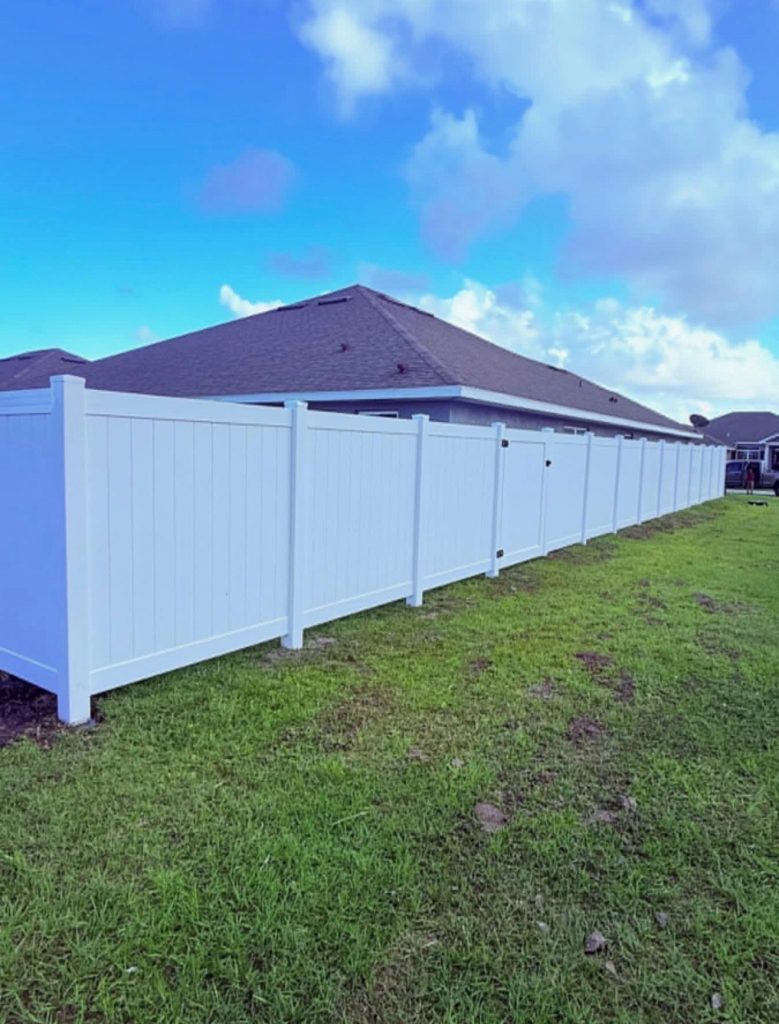
Shallow posts. A six-foot privacy fence is a sail. Every post on our fence work in Boca Raton gets set in concrete, deep enough for the wind load, because a fence is only as old as its weakest post. The long run in the photo at the top of this post is still standing straight for one boring reason: the posts went in right.
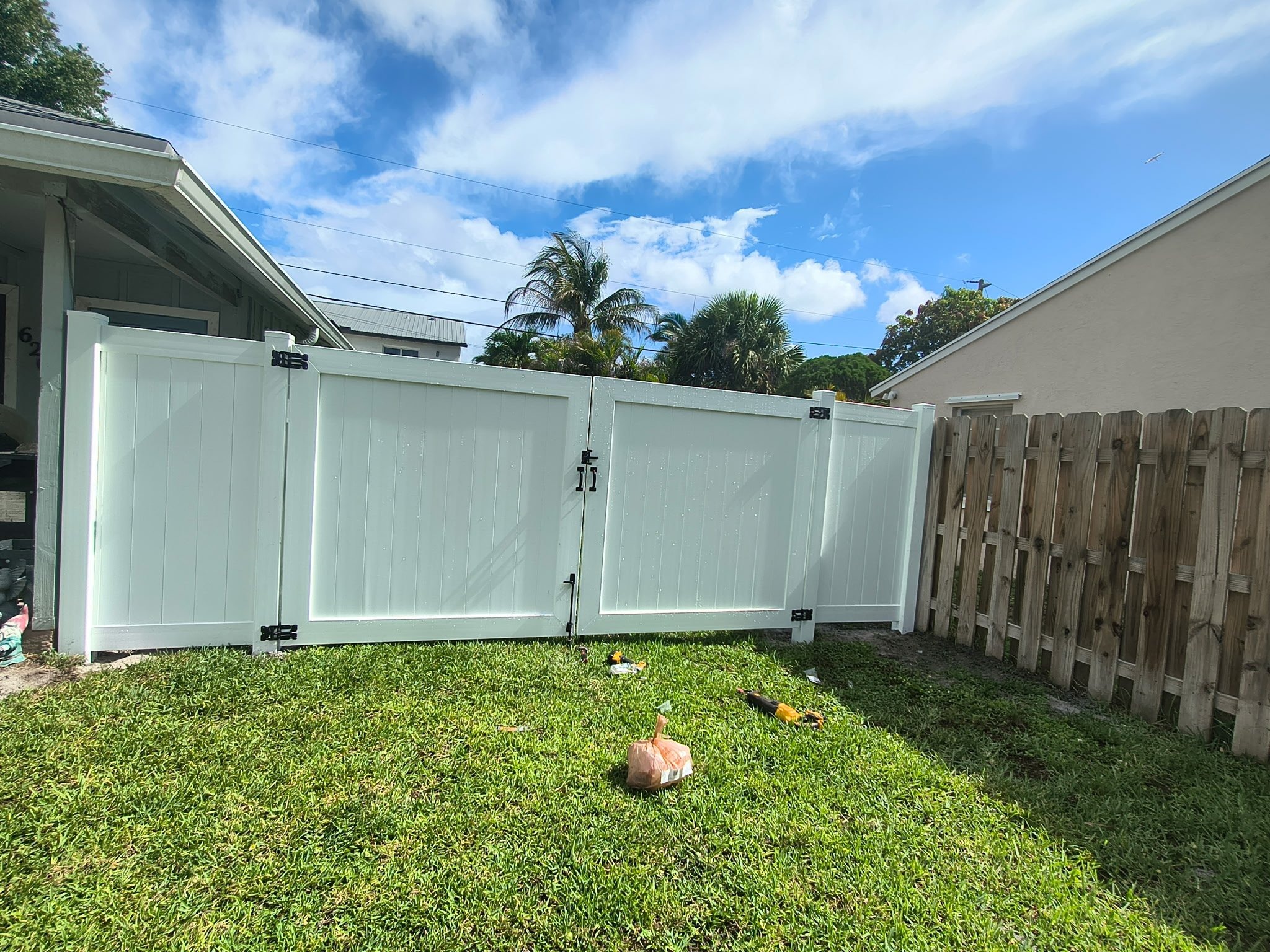
Gates hung wrong. Gates are the moving part, so they’re the failure point — the double gate in the second photo gets opened and closed every day. A gate that sags was hung on a post that couldn’t carry it. When I look at a fence someone else built, I go to the gate first. It tells me the whole story.
Sprinklers and string trimmers. A sprinkler head soaking the same panel base daily, and a trimmer chewing the bottom rail every week, will age a fence years ahead of schedule. Neither one is the fence’s fault.
What a storm does — and doesn’t — prove
One honest note, because this comes up every hurricane season: no fence material is storm-proof, and anyone who promises you one is selling. A well-built vinyl fence handles our normal storm winds season after season. A direct major-hurricane hit can take panels out of almost any fence — the difference is that a fence with properly set posts usually loses a panel, not the whole run, and panels can be replaced. A fence with shallow posts goes over in a line, posts and all, and that’s a replacement, not a repair.
The signs yours is near the end
- Posts lean or wiggle when you push at the top of the fence — the ground or the post base has let go.
- Panels crack instead of flexing, or break at the rails — the material has gone brittle from UV.
- Chalk on your hand when you rub a panel hard — the surface is breaking down.
- The gate won’t latch no matter how it’s adjusted — the posts have moved.
- You’re repairing a section every year. One repair is maintenance. A repair every season is a fence asking to be replaced — the same math I use for exterior paint: at some point you’re paying for the new one in installments, without ever getting it.
How to get the full 20 to 30 years
Buy the grade with real UV protection, set every post in concrete, hang gates on posts built to carry them, and wash the fence once in a while — soap, water, done. That’s the whole maintenance program. No sealing, no painting, no termite worries. It’s also why the cheapest vinyl quote deserves a second look: the savings usually come out of the panel grade or the post depth, and you pay for both later.
If it helps the planning: financing is available through Acorn Finance — small jobs from $120/month, typical projects in the low $200s–$300s/month, with rates as low as 4.49% APR — always with approved credit.*
FAQ
Is a vinyl fence really worth it over wood if it costs more up front?
Run the years, not the sticker. Wood at 10 to 15 years with upkeep, versus vinyl at 20 to 30 with a hose — most homeowners who plan to stay in the house come out ahead on vinyl, and they never spend a weekend sealing anything.
Can a damaged section be replaced, or do I need a whole new fence?
Usually just the section — that’s a real advantage of vinyl systems. If the posts are solid and the rest of the fence still flexes instead of cracking, we replace the damaged panels and rails and match the run. If the posts have let go everywhere, that’s a different conversation, and I’ll tell you straight.
Does vinyl get brittle in the Florida sun?
Bargain vinyl does — that’s the chalking and cracking above. Contractor-grade vinyl is made with UV protection specifically for climates like ours, and it keeps its flex for decades. Ask any fence company what UV protection is in their panel before you ask their price.
How do I clean a vinyl fence?
Soap, water, and a soft brush or a gentle rinse. Skip the aggressive pressure washing up close — you can force water where it doesn’t belong and scar the surface. Mildew spots in shaded areas come off with a mild cleaner. Fifteen minutes, a couple of times a year.
Wondering how many years yours has left?
Push a post. Rub a panel. If it leans, wiggles, or chalks, call me and I’ll walk the fence line with you — free estimate, honest answer, and I’ll tell you if a repair buys you real years or just buys time. Onel Construction LLC — Florida Certified General Contractor CGC1511492, serving Palm Beach, Broward, and Miami-Dade counties.
Call me: (561) 462-9293 — or send the details through our contact page and I’ll get you scheduled.
Price note in my own words: financing payments and any figures here are examples from recent jobs around here — set before the latest round of tariff-driven material price increases. They move with inflation, tariffs, and the market. Your free estimate always uses current numbers.
Financing is available on everything we do. Payments start at $120 a month on smaller jobs, and most projects land in the low $200s to $300s a month with approved credit. Rates run as low as 4.49% APR for qualified buyers. Ask at the free measure and we’ll lay the options out in writing, next to the estimate.
Insurance savings vary by carrier, policy, and home — figures shown are ‘up to’ amounts, not guarantees. Grant eligibility, amounts, and funding availability are determined by the program and may change. Financing subject to lender approval; rates and payments vary by credit profile. All financing examples assume approved credit through our financing partner.