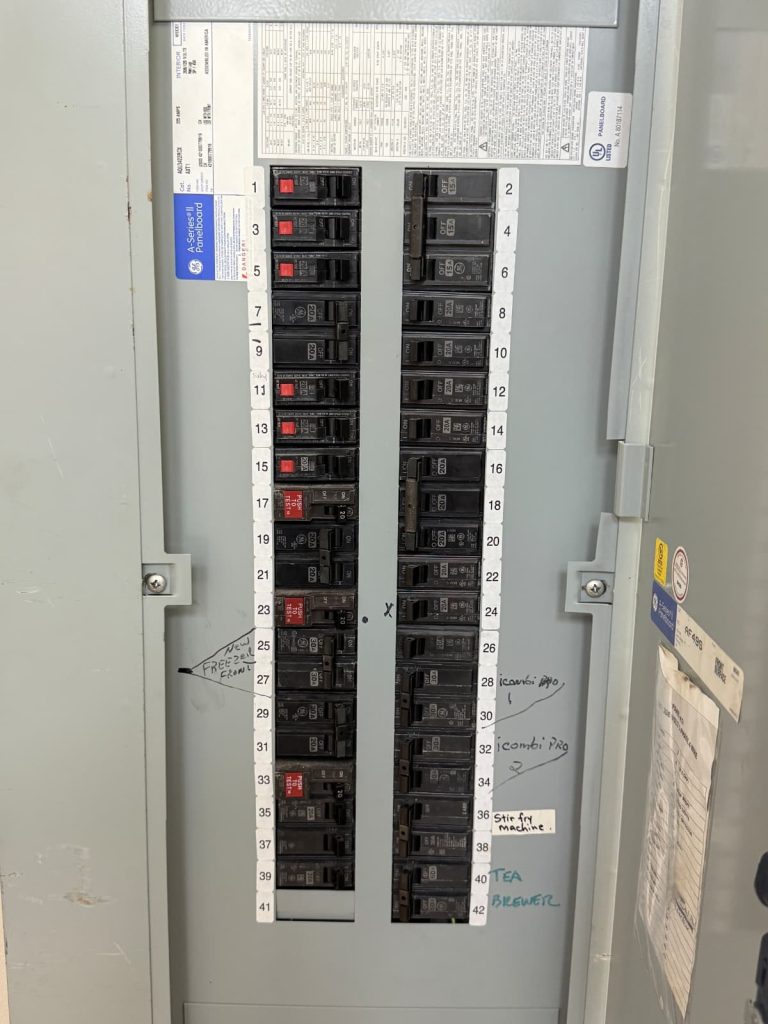
Short answer: yes. Almost every homeowner who calls me about a panel asks this hoping the answer is no — usually because somebody quoted them a cheaper price with no permit in it. I get it. A permit feels like paperwork. On a panel, it isn’t. It’s the record that a licensed electrician did the heart of your home’s electrical system right, and that an inspector checked it. Here’s how it actually works in South Florida.
Key takeaways
- Yes — replacing or upgrading an electrical panel in Florida requires an electrical permit, whether you’re going from 100 amps to 200 or swapping in a new panel at the same size.
- The permit has to be pulled by a licensed electrical contractor (or a certified general contractor covering the job) — a homeowner can’t hand this one to a handyman and make it legal.
- The job also needs utility coordination and a passed inspection. The power company disconnects and reconnects the service, and the city or county inspector signs off before the file closes.
- Swapping an outlet, a switch, or a light fixture like-for-like is a different story — that minor work generally doesn’t need a permit. A panel is not minor work.
- An unpermitted panel can come back at the worst times: a four-point insurance inspection, a sale, or a claim after an electrical fire, when everybody asks where the permit is.
Why a panel is never a “small job” in the code’s eyes
Your panel is the service equipment — the one place where power from the street meets every circuit in your house. Changing it means working on the service conductors, the grounding, and every breaker at once. That’s why Florida treats it differently from the small stuff. Palm Beach County’s own homeowner guidance lists like-for-like ceiling fans, light fixtures, outlets, and switches as no-permit work — a panel change is nowhere on that list, because it isn’t like-for-like maintenance. It’s a change to the wiring system itself.
And don’t let anybody tell you the newer small-project permit exemption covers it. Florida’s recent change letting some small single-family projects under $7,500 skip a permit specifically carves electrical work out — electrical, plumbing, structural, mechanical, and gas work still need a permit no matter what the job costs. A panel swap is electrical work at the highest level. Permit required, full stop.
This is also why the “same size, so no permit” argument fails. Going from an old 100-amp panel to a new 100-amp panel still replaces the service equipment, still gets inspected, and still needs the utility involved. Size isn’t the trigger. The panel itself is.
What the permit process actually looks like
When we handle a panel on our electrical work in Boca Raton, the sequence goes like this. First, a load calculation — what your home actually draws, and what the new panel needs to carry, especially if you’re adding an EV charger, a pool heater, or a bigger AC. Second, the permit application, pulled under a license, with the panel size and scope on it. Third, coordination with FPL (or your utility) to schedule the disconnect on install day and the reconnect after. Fourth, the work itself: old panel out, new panel in, every circuit reconnected, labeled, and tested, grounding brought up to current code. Fifth, the inspection — the city or county inspector checks the installation, and only a passed inspection closes the permit.
Is it an extra step? Yes. Does it add a little time? Sometimes a day or two of scheduling. What it buys you is a closed permit on public record that says this panel was installed legally — the exact record an insurance underwriter or a buyer’s inspector wants to see. I broke down what the job itself runs in what an electrical panel upgrade costs in South Florida — the permit and inspection are part of doing that job right, not an upsell bolted onto it.
What happens if you skip it
Picture this — it’s the most common version I see: a homeowner takes the cheaper no-permit quote, the panel goes in, and everything seems fine. Then the insurance company sends a four-point inspector, or they go to sell, and someone asks for the permit record on a panel that’s obviously newer than the house. There isn’t one. Now the work has to be permitted after the fact — which can mean opening things back up for inspection, paying the permit fees anyway (sometimes higher for work done without one), and explaining a gap that didn’t need to exist. If there’s ever an electrical fire, an unpermitted service change is also the first thing that gets looked at hard. I’m not saying that to scare you. I’m saying the permit is cheap insurance compared to any one of those phone calls.
FAQ
Can I pull the panel permit myself as the homeowner?
Florida’s owner-builder rules exist, but a panel isn’t where most homeowners should use them — you’d be taking legal responsibility for service work, and you’d still need the work to pass inspection and the utility coordination to line up. In practice, panel permits are pulled by the licensed electrical contractor doing the job. If a quote doesn’t include the permit being pulled by a license, that’s your answer about the quote.
How long does the permit and inspection add to a panel job?
The install itself is usually a day. The permit and the utility disconnect/reconnect are scheduling around that day — in most of the cities we work in across Palm Beach, Broward, and Miami-Dade, plan on the whole thing being coordinated over a few days, not weeks, when it’s filed cleanly up front. Emergency replacements are handled case by case with the local building department — call first, don’t assume.
Do I need a permit to replace a single breaker?
Replacing a failed breaker or doing genuinely minor like-for-like repairs is a different category from replacing the panel — that’s maintenance, not a service change. The line is the panel and the service itself: once you’re replacing the box, the feed, or the capacity, you’re in permit territory. When in doubt, ask the building department — or ask me, and I’ll tell you straight.
Will a permitted panel job help with insurance?
It can. Insurers look hard at old, flagged panels on four-point inspections, and a new panel with a closed permit and a passed inspection is exactly the documentation they ask for. No contractor can promise a specific premium change — savings are up to amounts and vary by home and carrier — but an undocumented panel gives an underwriter a reason to say no, and a permitted one takes that reason away.
Not sure if your panel job needs a permit? Ask before you sign anything
If a contractor is telling you a panel swap doesn’t need a permit in Florida, get that in writing — and then call me before you sign. Free estimate, straight talk: I’ll look at your panel, tell you exactly what your city requires, and price the job with the permit, the utility coordination, and the inspection handled. Onel Construction LLC — Florida Certified General Contractor CGC1511492, serving Palm Beach, Broward, and Miami-Dade counties.
Call me: (561) 462-9293 — or send the details through our contact page and I’ll get you scheduled. Financing is available through Acorn Finance for bigger electrical work — small jobs from $120/month, typical projects in the low $200s–$300s/month, with rates as low as 4.49% APR — always with approved credit.*
*Price note in my own words: the figures here are averages from recent jobs around here — set before the latest round of tariff-driven material price increases. They move with inflation, tariffs, and the market. Your free estimate always uses current numbers.
Financing is available on everything we do. Payments start at $120 a month on smaller jobs, and most projects land in the low $200s to $300s a month with approved credit. Rates run as low as 4.49% APR for qualified buyers. Ask at the free measure and we’ll lay the options out in writing, next to the estimate.
Insurance savings vary by carrier, policy, and home — figures shown are ‘up to’ amounts, not guarantees. Grant eligibility, amounts, and funding availability are determined by the program and may change. Financing subject to lender approval; rates and payments vary by credit profile. All financing examples assume approved credit through our financing partner.