
When most people hear “aging in place bathroom,” they picture a full wheelchair roll-in shower. Zero entry. Curbless. The whole ADA playbook.
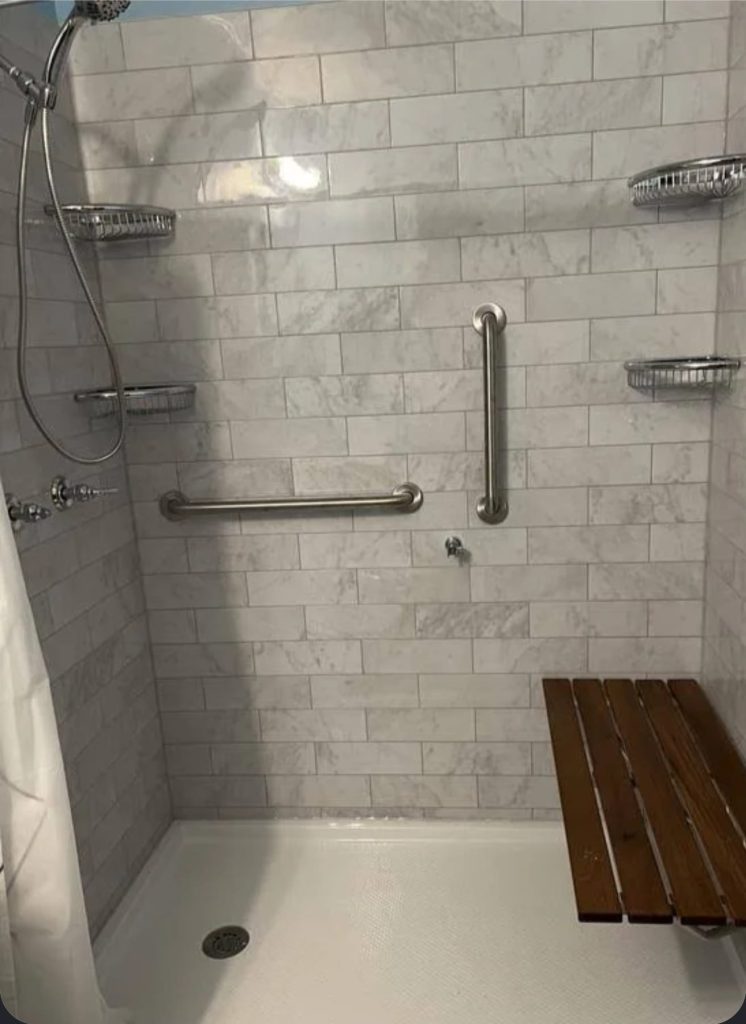
Here’s my honest take after fifteen years of remodeling bathrooms for people in their 60s, 70s, and 80s: unless the person is actually in a wheelchair, that’s overkill. What most elderly homeowners need — and what I build most often — is a tub-to-shower conversion with a low threshold of about three inches, a built-in seat, and properly anchored grab bars.
It’s safer than climbing over a tub. It costs less than full ADA. And it’s a much simpler conversation with the municipality on permits and inspections.
Now let me be crystal clear about something: this is not an ADA shower. An ADA-compliant roll-in shower is designed for wheelchair users, with specific dimensions and requirements spelled out in code. I’m not claiming otherwise, and anyone who tells you a non-ADA shower “meets ADA” is selling you something. I can build full ADA when it’s genuinely needed — I have, and I will. But ADA shouldn’t be the default. It should be the answer to a specific question: is there a wheelchair in this house?
The real enemy is the tub
Let’s start with what I actually see on jobs. The overwhelming majority of aging-in-place bathroom work starts the same way: a tub nobody uses anymore, with a wall 14 to 18 inches high that somebody has to climb over every morning. That’s the hazard. That’s where the falls happen — wet foot, high step, hard porcelain.
So the conversion itself is the big win. We take the tub out, rework the drain, and build a walk-in shower where you step in at nearly floor level instead of climbing over a wall. That single change removes the most dangerous moment in the bathroom. Everything else — the seat, the grab bars, the wand — builds on that foundation.
Why I like the three-inch threshold
A full curbless, zero-entry roll-in looks great in photos, and when there’s a wheelchair, it’s the right call. But for everyone else, here’s what I’ve learned:
A three-inch threshold is nothing to step over. It’s a small lip — easy for anyone who walks, even unsteadily. It keeps the “walk right in” feel without going fully curbless.
It keeps water where it belongs. A curbless shower is an engineering exercise: precise floor slopes, linear drains, careful waterproofing detailing at every edge, because there’s nothing stopping water from walking out of the shower. A small threshold is a simple, physical water stop. Water stays in. The floor stays dry.
It costs less. Curbless means more labor hours, more waterproofing detail, often a linear drain — and in some cases reworking the subfloor to create the slope. A low-threshold pan is a straightforward build. You’re paying for the shower, not the engineering puzzle around it.
And yes — fewer headaches with the municipality. This part matters more than people think. Curbless and roll-in showers draw extra scrutiny from inspectors on drainage and waterproofing, because there’s no margin for error when there’s no curb. More scrutiny means more inspection visits, more back-and-forth, more time. A low-threshold shower with proper waterproofing sails through the standard inspection process. Same permit, simpler path. I’m not dodging permits — I pull them on every job — but I don’t volunteer my customers for a harder inspection than they need.
The seat and the grab bars — non-negotiable
Whatever the threshold, two things go in every aging-in-place shower I build:
A built-in seat. Tiled bench, solid, part of the structure. Not a plastic stool from the pharmacy — a real seat you can trust your weight on, every day, for years. Most people end up using it more than they expected. Shaving legs, resting a knee, just sitting under the hot water on a bad day. It’s the feature that gets thanked-for the most.
Grab bars anchored to real blocking. This is the part where cheap work reveals itself. Grab bars need wood blocking inside the wall — solid lumber, bolted to structure — installed while the walls are open. The suction-cup bars and the ones screwed into tile with drywall anchors are decorations. A grab bar that pulls out of the wall when somebody actually grabs it is worse than no grab bar at all, because it creates false confidence. We open the walls anyway during a conversion. Blocking goes in. No exceptions.
Add a handheld shower wand and you’re done. Sitting on the bench, standing, rinsing down the shower — it does everything. Comfort-height toilet and good lighting round it out, and you’ve got a bathroom that works for someone at 75 and works just as well for everyone else in the house.
When full ADA is the right answer
I want to say this plainly because it matters: if someone in the home uses a wheelchair, or there’s a real chance they will soon, we build full ADA. Zero entry, the turning clearances, the grab bar placements per the actual standards — done right, permitted, inspected. I’ve done it and I’ll do it again.
The mistake is treating ADA as the starting point for everyone. It’s a specific solution for a specific need. For the homeowner who’s steady on their feet but doesn’t want to climb over a tub anymore — which is most of my aging-in-place customers — the low-threshold conversion with a seat and grab bars is safer than what they have, cheaper than what they don’t need, and done in a simpler build.
What it costs — the honest version
I’m not quoting your bathroom from behind a keyboard. But here’s how the money usually works out: a small bathroom refresh can run around $189 a month financed. Typical full remodels — the tub-to-shower conversion, new tile, new vanity — land in the $200s to $300s a month range, rates as low as 4.49% APR on approved credit through Acorn Finance.
And here’s the part that connects to the thesis: skipping the full curbless ADA build keeps you out of the most expensive version of this job. Less subfloor rework, less specialized drainage, fewer inspection rounds. The low-threshold conversion is the sweet spot — maximum safety gain per dollar.
What to do next
Free in-home estimate. I look at the bathroom, we talk about who’s using it and what they need — tub-to-shower, aging-in-place features, full ADA if that’s what’s called for — and I give you a real number in writing.
Got a written quote already? I’ll beat it or hand you $50. Beat-the-Quote ends October 1st.
Call or text (561) 462-9293. I’m Joe.